

Artificial intelligence is everywhere ChatGPT, Claude, Gemini, Copilot. These tools write emails, summarize reports, and even explain complex ideas. They sound intelligent. Sometimes, they even sound human.
But here’s the truth: they don’t think. They predict.
Large Language Models (LLMs) are not digital minds or conscious beings. They’re incredibly advanced autocomplete systems mathematical tools trained to guess what word probably comes next. That’s all.
It may sound simple, but when you scale that process up to billions of words and trillions of calculations, something remarkable happens. The machine starts producing language that feels natural, even thoughtful. And that’s what makes this technology so powerful and so misunderstood.
The Simple Trick Behind the Magic
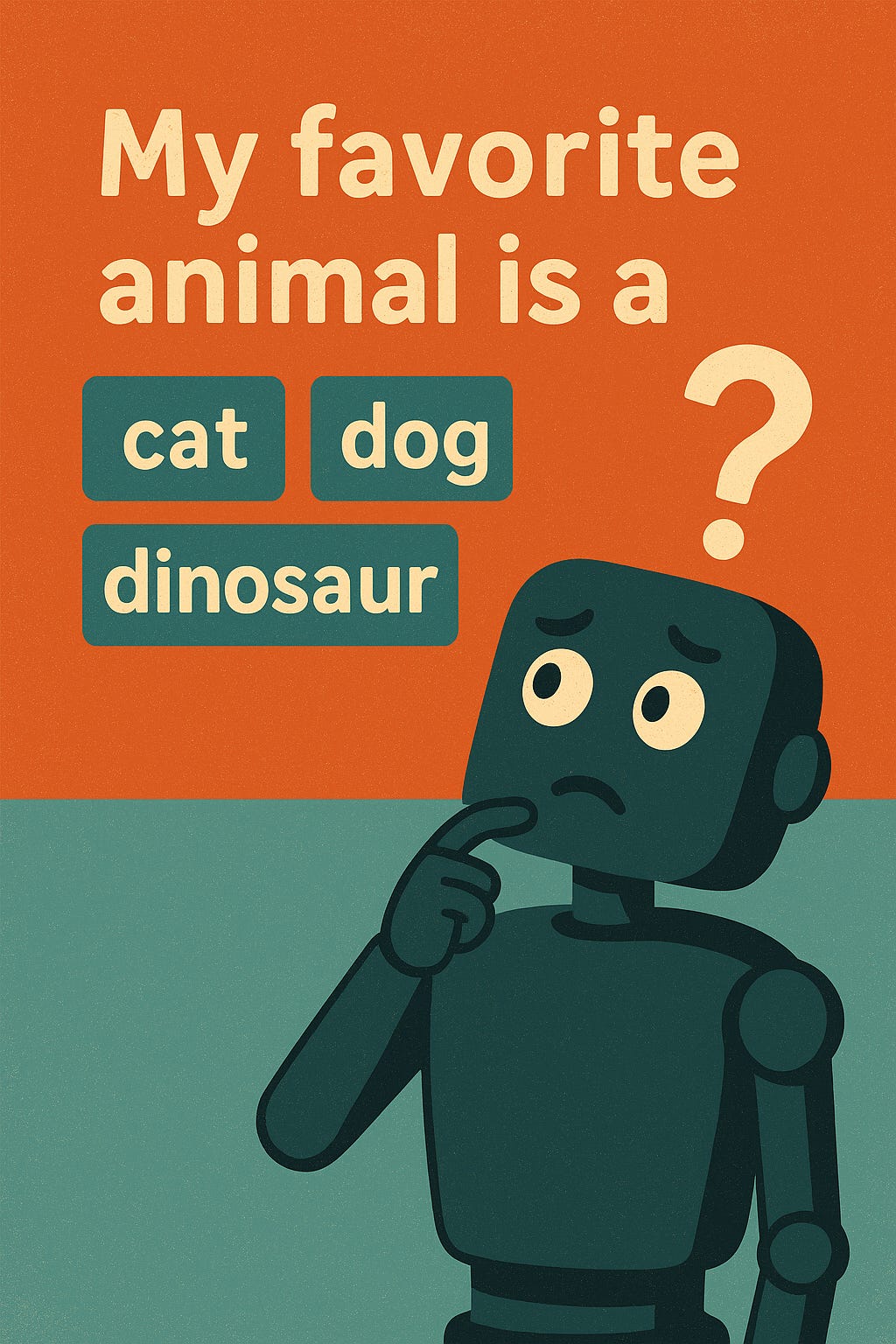
Imagine you type:
“The weather today is…”
A regular autocomplete might guess “sunny” or “rainy.” A large language model does the same thing just at a much larger scale. It looks at everything it’s seen in its training millions of sentences about weather, seasons, and everyday speech and predicts which word best fits next. It might decide “sunny” is most likely, write it down, and then repeat the process for the next word.
Step by step, word by word, it builds a complete thought.
Every email, essay, or poem that an LLM produces comes from this same loop: predict → add → repeat. There’s no understanding involved, just probability and pattern recognition done at an enormous scale.
That’s what makes it so impressive and so different from how we think.
Why AI Suddenly Feels Smart
This idea predicting the next word isn’t new. What changed is how well we can do it. Three things came together in the past few years that transformed AI from clumsy chatbot to fluent writer.
Massive Amounts of Data
For decades, computers lacked the examples they needed to understand language structure. Then the internet arrived and suddenly, there were billions of books, websites, and conversations to learn from.
Every story, article, social post, and tutorial became part of a giant collection of human language. AI doesn’t memorize that data it studies the patterns: how words connect, how ideas flow, how tone shifts.
The result? It learned to sound human.
Huge Computing Power
Modern computer chips can perform trillions of calculations every second. Training one large model can take weeks or even months of constant processing across thousands of servers.
This is where cloud computing comes in. What used to require a supercomputer can now happen in massive data centers shared across the world. That scale gives today’s AI the brainpower to recognize patterns far too complex for humans to program manually.
Smarter Design
In 2017, researchers introduced something called the transformer architecture and it changed everything.
Earlier AI systems could only handle short phrases. Transformers gave AI the ability to consider whole paragraphs or pages at once. Instead of reacting to a few nearby words, it could see the full context of a conversation.
That’s what made it capable of writing essays, following instructions, and staying coherent across long answers.
In short: data gave it knowledge, computing gave it power, and transformers gave it memory-like awareness. Together, they made modern AI possible.
Why It Sounds Smart But Isn’t
The biggest misunderstanding about LLMs is that they understand what they’re saying. They don’t.
They’ve simply become extremely good at predicting what sounds right. If you’re talking about rivers, the word “bank” means one thing; if you’re talking about finance, it means another. The AI doesn’t know the difference it just notices which version fits the pattern in your text.
That’s why language models feel so human. They’ve read so much of our writing that they can reproduce its rhythm and structure perfectly. But the illusion of understanding is just that an illusion.
They don’t know what a riverbank looks like, or what it feels like to make a bank deposit. They’ve never seen, touched, or experienced the world they describe. They only know how words tend to appear next to each other.
It’s prediction, not comprehension.
Inside the Machine: How Learning Without Knowing Works
Imagine a web of billions of tiny connections each one a digital “neuron.” As the AI reads examples during training, it adjusts the strength of these connections over and over, trying to reduce its mistakes.
If it predicts the wrong word, it tweaks the connections slightly. Do that billions of times, and the network gradually tunes itself to language like a musician who learns a song by ear, one note at a time, until it sounds right.
That’s how a model “learns” grammar, tone, and structure. Not by memorizing rules, but by absorbing patterns.
The transformer architecture makes this process efficient by letting the model “pay attention” to the most important words in a sentence the ones that shape meaning.
So when it writes, it isn’t recalling facts. It’s activating patterns it’s seen before and recombining them into something new. Every answer it gives is a fresh prediction, not a stored memory.
The Hidden Limits of AI
Even with all this complexity, large language models face hard limits the kind that come from how they’re built, not how they’re trained.
They Have Short Memories
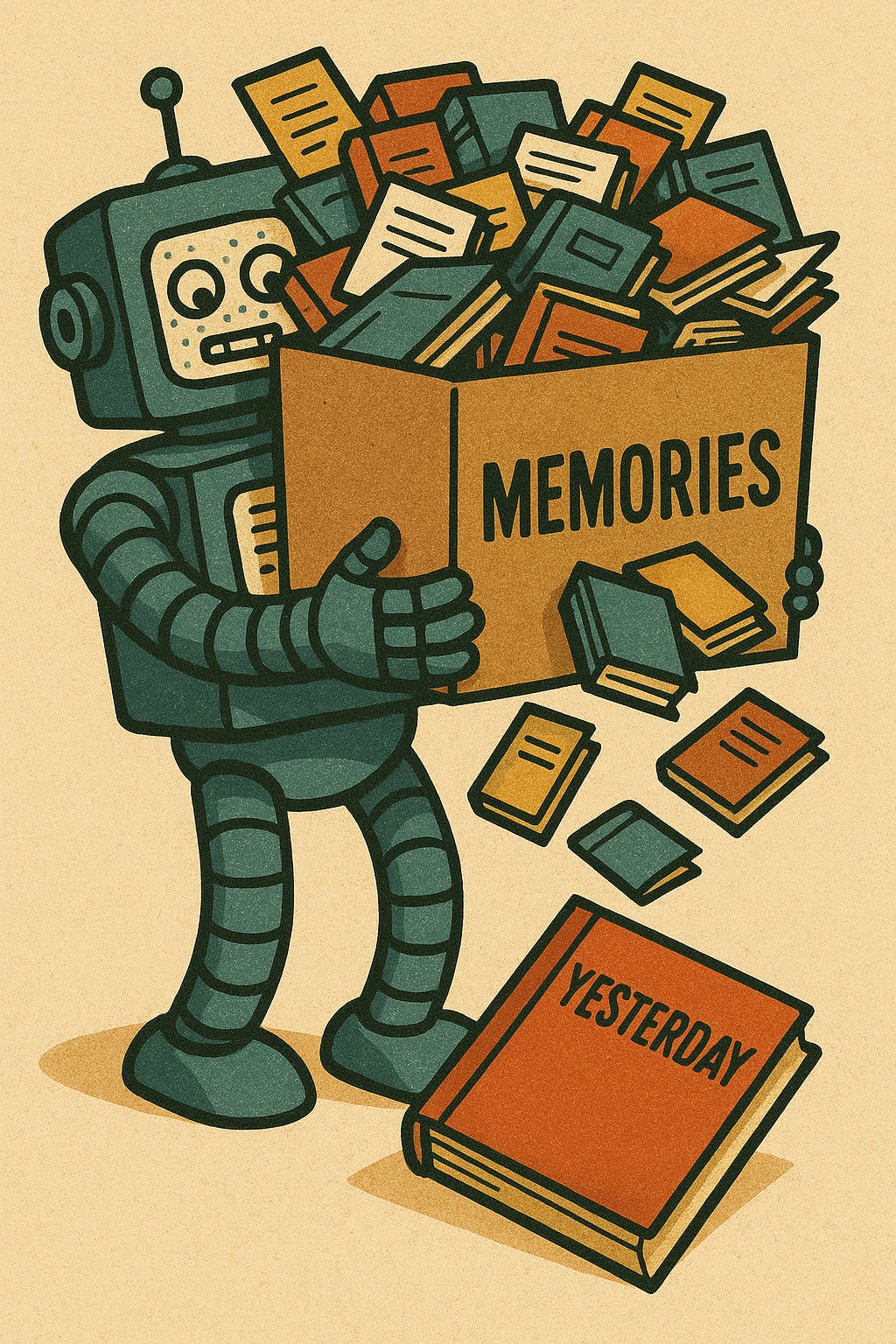
An LLM can only see a fixed number of words at a time this is called its context window. Once that fills up, older parts of the conversation fall away.
That’s why an AI might lose track of what you said ten minutes ago. It’s not being forgetful; it’s just out of space. Unlike people, it doesn’t have long-term memory. It only reacts to what’s currently visible.
They’re Expensive to Run
Every single word an AI writes requires thousands of calculations. Multiply that by hundreds of words, and you get serious computing costs. That’s why models live in giant data centers not on your laptop.
Running or training them uses enormous amounts of electricity and specialized hardware. Scaling them up further is possible, but not infinite. There are physical and financial limits.
They Can’t Learn on Their Own
An AI model doesn’t automatically keep up with the news or learn from new information. Its knowledge stops the day its training data ends that’s why it sometimes can’t answer questions about recent events.
To “update” an AI, researchers must retrain it on fresh data an expensive and time-consuming process.
They Don’t Truly Understand
LLMs can write about love, pain, or hope, but they don’t experience them. They can describe a sunset but can’t see its color. They can analyze your writing but don’t know what it’s like to care about what you’re saying.
Their words sound thoughtful because they’ve seen how thoughtful writing looks not because they think or feel anything themselves.
Prediction vs. Understanding
Here’s the key distinction:
Prediction is about what usually comes next.
Understanding is about why it should come next.
Large language models excel at prediction. They can create text that flows beautifully and sounds informed. But they don’t have the “why.”
That’s why they can sometimes produce confident nonsense. They’re not lying they just don’t have a way to know they’re wrong. They’re designed to be fluent, not factual.
Their job isn’t to reason. It’s to guess, very convincingly.
The Many Kinds of Large Language Models
Not every LLM is the same. Each one is built for different goals, from raw creativity to deep specialization.
Base models are the raw brains. These are the unrefined versions trained on massive amounts of text. They know language in general but can’t follow instructions reliably. Imagine a musician who can play any tune but doesn’t take requests.
Instruction-tuned models are the polite conversationalists. They’ve been trained to understand what people mean when they ask something. They’re the version most people meet ChatGPT, Claude, Gemini. They can take direction, stay on topic, and use tone appropriately.
Domain-specific models are the specialists. Some are trained for medicine, others for law, science, or code. They use data from those fields to speak the right “language.” They’re brilliant within their area but often lost outside it like a surgeon trying to write a comedy script.
Multimodal models are the multitaskers. They can handle more than just text reading images, charts, or even listening to audio. You can upload a photo of a diagram and ask it to explain. They merge pattern recognition across different types of data, though the same rule applies: they don’t understand; they just detect patterns.
Compact or edge models are the small, portable versions designed to run on your phone or laptop. They’re faster and cheaper, but less capable. Perfect for quick text tasks, not deep research or analysis.
All of these versions share the same DNA the same idea of predicting what comes next. They just vary in size, focus, and purpose.
The Bottom Line: They Don’t Understand You They Predict You
Large language models aren’t thinking machines. They’re astonishing pattern recognizers, powered by data, math, and scale.
They feel intelligent because they’ve seen enough human writing to imitate it convincingly. But their strength isn’t understanding it is consistency.
They’re tools powerful ones for turning language into action. Used wisely, they can help people write faster, explain ideas better, and think more clearly.
The story of AI isn’t about machines becoming human. It’s about humans learning to work with machines that finally speak our language even if they don’t understand it.